Stockpile Volume Calculator: The Formula and Its Limits
A stockpile volume is the amount of material sitting above a reference base — the toe of the pile: capture the pile surface, define the base it sits on, and the volume is the space between them. Every stockpile volume calculator you will find online is one formula behind a form, and it is worth knowing exactly what that formula assumes — because on a real yard those assumptions are what decide whether the number is usable.
Stockpile volume calculator
A cone, a flat-topped pile or an elongated pile on level ground. Enter what you measured; the formula and what it assumes are shown under the result.
Formula: V = π · r² · h / 3
r: base radius · h: height
Assumes level ground under the pile and straight sides. A flat top is treated as a truncated cone, an elongated pile as a triangular ridge with a half cone at each end, and the wall option as half of the pile.
A real site is rarely this regular. Measure the surveyed surface instead: Stockpile Measurement Software
Volume above a base
A stockpile volume is the amount of material sitting above a reference base — the toe of the pile. Capture the pile surface, define the base it sits on, and the volume is the space between them.
The pile surface usually comes from a drone or LiDAR survey; the base is defined from the surrounding ground or a fitted plane.
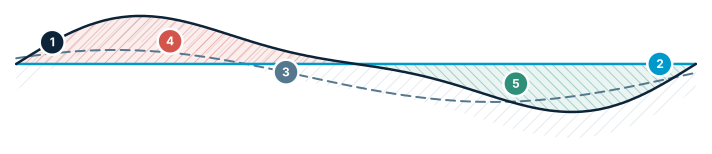
Cut / Fill — three reference modes
Same terrain, three references → three different volumes. The most confusing point for users.
- Existing terrain — the surveyed surface
- Flat level — a fixed design elevation
- Reference surface — another scenario or design
- Cut — above the reference → removed
- Fill — below the reference → added
The calculator formula, and what it assumes
A stockpile volume calculator treats the pile as a right circular cone: V = π × r² × h / 3, where r is the radius of the base and h is the height at the apex. For a freshly tipped, free-standing pile on flat ground that is a reasonable first estimate.
The accuracy is not a property of the arithmetic — it is a property of how closely the pile matches a cone. Three assumptions carry all of the risk: the base is a full circle, the material rises to a single apex, and the ground under the pile is flat. Each one can be checked against the pile in front of you.
| Pile situation | What the formula assumes | Effect on the volume |
|---|---|---|
| Free-standing pile, flat ground | A circular base, a single apex and one uniform side slope — freshly tipped material | Usable as a rough check |
| Flat-topped pile | Material rises to a single apex | Understates: with a top radius half the base radius the pile holds 1.75× the cone volume, so the formula returns about 57% of it |
| Pile against a wall or bund | The base is a full circle | Overstates: half a pile measured as a full circle doubles the volume |
| Height from an assumed repose angle | Material rests at a known angle of repose, so height follows from the base radius | Volume scales with the tangent: near 35°, a 2° error moves it about 8%, a 4° error about 16% |
| Sloping or soft ground | The base is a horizontal plane at the toe | Error follows the ground, in either direction |
| Partly reclaimed or uneven pile | Symmetry around a single axis | No symmetry left for a formula to use |
Why the base definition matters
Most of the error in a stockpile volume comes from how the base is defined. A pile on flat, hard ground is straightforward; a pile against a wall, on a slope, or on soft ground needs a base that reflects reality.
Good software offers several reference modes for the base so you can match the actual toe of the pile.
From a calculator to a surveyed surface
A survey replaces each of those assumptions with a measurement. Instead of one radius and one height, a drone or LiDAR survey captures the whole pile surface, and the volume is computed between that surface and a base you define. A flat top, a wall behind the pile, an uneven face or a partly reclaimed pile then become part of the measured shape rather than sources of error.
It also explains why the same pile can produce different numbers from different people: the arithmetic is not what differs, the base is. Settling the base definition is worth more than any refinement of the formula.
From volume to tonnage
Volume alone is rarely the final answer. Multiplying volume by the material's density converts it to tonnage, which is what inventory and reconciliation reports use. Because density varies by material and compaction, it should be set deliberately.
Frequently asked questions
What is stockpile volume?
Stockpile volume is the amount of material sitting above a reference base — the toe of the pile. You capture the pile surface (usually from a drone or LiDAR survey), define the base it sits on from the surrounding ground or a fitted plane, and the volume is the space between the two.
Why does the base definition matter so much for stockpile volume accuracy?
Most of the error in a stockpile volume comes from how the base is defined. A pile on flat, hard ground is straightforward, but a pile against a wall, on a slope, or on soft ground needs a base that reflects reality — which is why good software offers several reference modes to match the actual toe of the pile.
How do you convert stockpile volume into tonnage?
Volume alone is rarely the final answer: multiplying volume by the material's density converts it to tonnage, which is what inventory and reconciliation reports use. Because density varies by material and compaction, it should be set deliberately rather than assumed.
Where does the pile surface data typically come from?
The pile surface usually comes from a drone or LiDAR survey, while the base is defined from the surrounding ground or a fitted plane.
Can I use a stockpile volume calculator?
Yes, as a rough check on a clean, free-standing pile: a stockpile volume calculator applies the cone formula V = π × r² × h / 3 using the base radius and the apex height. It stops being reliable as soon as the pile has a flat top, sits against a wall, rests on sloping ground or has been partly reclaimed, because each of those breaks one of the assumptions the formula is built on.
Why does a flat-topped pile break the cone formula?
The cone formula assumes the material rises to a single apex, and a flat-topped pile holds extra material where the tip would be. With a top radius half the base radius, the real pile holds 1.75 times the cone volume, so the formula returns about 57% of the true figure.
How much does an assumed angle of repose affect the result?
When the height is not measured but inferred from an assumed angle of repose, the volume scales with the tangent of that angle. Near 35 degrees, a 2 degree error moves the volume by roughly 8% and a 4 degree error by roughly 16%, which is why an assumed repose angle is a weak substitute for a measured height.
How do you calculate the volume of an elongated stockpile?
Treat it as a ridge with a triangular cross-section and a half cone at each end: V = (L − W) × W × h / 2 + π × (W/2)² × h / 3, where L is the length toe to toe, W the base width and h the height. It still assumes level ground and straight sides; the calculator on this page applies it, and a pile that is not this regular needs a surveyed surface.
How do you calculate the volume of an uneven stockpile?
An uneven pile has no symmetry for a formula to exploit, so the volume has to come from the measured surface: capture the pile with a drone or LiDAR survey, define the base at the toe, and compute the volume between the two. It is the same procedure as for a regular pile — it is simply the case where the formula has nothing left to offer.
Sources
Try STREAM's stockpile measurement software
Native Windows · fully offline · free beta