Burden and Spacing: Laying Out a Blast Pattern
Burden is the rock standing in front of a hole. Spacing is the distance between holes in the same row. Those two numbers, plus the depth of each hole, are most of what decides whether a bench breaks cleanly to the design floor. This is what each one does, what goes wrong at either extreme, and why a distance measured on plan is not the burden a hole actually sees.
Burden and spacing, defined
Burden is the distance from a hole to the free face it is breaking towards — or, for holes behind the first row, to the row in front of them — measured perpendicular to the row. Spacing is the distance between adjacent holes within a row.
Neither is chosen in isolation. Both are normally derived from hole diameter together with the rock and the explosive being used, and then adjusted from what the last few blasts actually did.
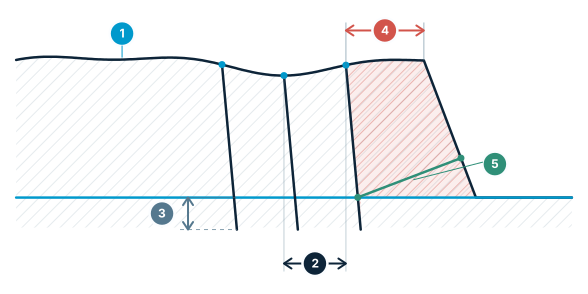
Burden and spacing — plan burden is not the burden
Hole depth comes from the bench surface, and the rock actually standing in front of a hole differs from the plan distance.
- Collar elevation — each collar read from the DEM — a bench top is never flat
- Burden between rows — distance from the front row to the row behind it
- Subdrill — the extra depth below the floor level
- Plan burden — horizontal distance to the crest — misleading on a battered face
- True burden — measured at floor level, perpendicular to the hole axis
What goes wrong at each extreme
Too little burden and the energy takes the shortest way out: airblast, flyrock, and rock thrown further than anyone wants. Too much burden and the energy has nowhere to go: coarse fragmentation, toe left standing at the floor, and more of the charge spent on ground vibration.
Spacing behaves the same way in the other direction. Holes too close together waste explosive on ground that is already broken; too far apart and ridges are left between them.
Square or staggered
A square grid puts every hole directly behind the one in front. A staggered grid offsets alternate rows so each hole sits between the two ahead of it, which distributes the energy more evenly across the block.
Whichever grid is used, the front row is the one that has to follow the face rather than the grid. A crest is never straight, and a front row laid out to a rigid grid gives one hole two metres of burden and the next one six.
Hole depth comes from the bench, not from a number
A surveyed bench top is never flat. Reading each collar elevation off the terrain model and taking the floor from the design gives a depth per hole rather than a single depth for the pattern, with subdrill added below the floor so the bench breaks to level.
For inclined holes the drilled length is longer than the vertical depth, and that difference is what the drill crew works to.
Plan burden is not the burden
Measuring from a hole to the crest on plan gives one number. The rock actually standing in front of that hole is a different number at every elevation, because the face is battered and the hole is inclined.
On a face that leans out towards the muck the rock in front of the hole grows with depth, so the plan distance to the crest understates what the toe actually has to break — which is where toe problems start. Measuring relief along the hole axis rather than on plan is what finds it before the hole is charged.
Powder factor closes the loop
Powder factor is the mass of explosive per unit volume of rock, and it is how two different patterns get compared on the same terms. The volume side of it falls straight out of the geometry: burden times spacing times bench height gives the rock assigned to each hole.
The charge side — which explosive, how much, how it is decked and initiated — is the blasting engineer's decision, and no amount of pattern geometry substitutes for it.
Design versus as-drilled
The collars the crew actually drills are never exactly the collars on the plan. Loading the as-drilled positions back in and comparing them with the design turns that gap into a measurement instead of an argument.
The important detail is that measured values stay separate from designed ones. Overwrite the design with what was drilled and the deviation — the thing worth knowing — disappears.
Frequently asked questions
What is the difference between burden and spacing?
Burden is the distance from a hole to the free face it is breaking towards — or, for holes behind the first row, to the row in front of them — measured perpendicular to the row. Spacing is the distance between adjacent holes within a row.
What happens if the burden is too small or too large?
Too little burden and the energy takes the shortest way out, producing airblast and flyrock. Too much burden and the energy has nowhere to go, producing coarse fragmentation, toe left standing at the floor, and more of the charge spent on ground vibration.
Why is a staggered pattern used instead of a square one?
A square grid puts every hole directly behind the one in front, while a staggered grid offsets alternate rows so each hole sits between the two ahead of it, which distributes the energy more evenly across the block.
Why is plan burden misleading on a battered face?
Measuring from a hole to the crest on plan gives one number, but the rock standing in front of that hole differs at every elevation because the face is battered and the hole is inclined — on a face that leans outward the burden grows with depth, so the plan figure understates what the toe has to break, which only shows up when relief is measured along the hole axis.
How is powder factor related to the pattern geometry?
Powder factor is the mass of explosive per unit volume of rock. The volume side comes straight from the geometry — burden times spacing times bench height gives the rock assigned to each hole — while the charge side remains the blasting engineer's decision.
Lay out blast patterns in STREAM
Native Windows · fully offline · free beta